


1. 서 론
1.1. 연구 배경
1.2. 연구 목적
2. 연구 방법
2.1. 연구설계
2.2. 연구절차
3. 연구결과
3.1. 연구 및 대상자 관련 특성
3.2. 포함 문헌의 질 평가
3.3. 중재 관련 특성
3.4. 결과변수 및 평가 관련 특성
3.5. 주요 중재 결과
4. 논 의
5. 결 론
1. 서 론
1.1. 연구 배경
비만은 전 세계적으로 유병률이 지속적으로 증가하고 있는 대표적인 공중보건 문제이다. 세계보건기구(World Health Organization [WHO], 2024)에 따르면 2022년 전 세계 성인의 43%가 과체중, 16%가 비만에 해당하였으며, 전 세계 비만 유병률은 1990년 이후 두 배 이상 증가한 것으로 보고되었다. 비만은 제2형 당뇨병, 고혈압, 이상지질혈증, 심혈관질환 등 다양한 만성질환의 위험을 높일 뿐 아니라 의료비 지출 증가와 생산성 저하 등 사회경제적 부담을 초래한다(Goettler, Grosse, & Sonntag, 2017; Kumanyika, Jeffery, Morabia, Ritenbaugh, & Antipatis, 2002).
국내에서도 성인의 비만 및 복부비만 유병률은 지속적으로 증가하고 있으며 비만 관련 동반질환의 위험 또한 유의하게 높아지고 있다. 특히 근로자 비만은 개인의 건강 문제를 넘어 조직과 사회 전반에 영향을 미치는 중요한 산업보건 이슈이다(Bae et al., 2025). 비만한 근로자는 만성질환 위험 증가뿐 아니라 피로, 이동과 일상·직무활동의 제한, 근로능력 및 삶의 질 저하를 경험할 가능성이 있으며, 이러한 문제는 결근, 업무 중 생산성 저하 및 장애 관련 생산성 손실로 이어져 조직의 생산성 손실과 경제적 부담을 가중시킬 수 있다(Goettler et al., 2017; Shrestha, Pedisic, Neil-Sztramko, Kukkonen-Harjula, Hermans, 2016). 더욱이 근로자는 대부분의 시간을 직장에서 보내므로 직장 환경은 식이, 신체활동, 식생활, 수면, 스트레스 대처행동 등 건강행동 형성에 직접적인 영향을 미치는 핵심 생활터라 할 수 있다(Jeong, 2021; Weerasekara et al., 2016).
실제로 장시간 불규칙한 식사, 교대근무, 업무량 및 직무 스트레스 증가와 낮은 자율성 등은 근로자의 비만 위험을 증가시키는 주요 요인으로 보고되고 있다(Choi, Kim, & Kim, 2023; Sun et al., 2018; Sung, Song, Choi, & Park, 2016). 선행연구에서 직장을 기반으로 한 체중관리 중재는 식이 관리, 신체활동, 행동수정, 건강상담, 모바일 및 웹 기반 디지털 헬스, 인센티브 요소 등 다양한 구성요소를 복합적으로 적용하여 근로자의 체중 감량과 건강행동 개선을 도모하고 있다(Shrestha et al., 2016; Weerasekara et al., 2016). 또한 이러한 중재는 대면 교육, 모바일 애플리케이션, 웹 기반 프로그램, 혼합형(hybrid) 방식 등 다양한 전달방식으로 운영되고 있으며 중재 기간, 빈도, 제공자 및 운영 전략 또한 연구마다 다양하게 보고되고 있다. 이러한 중재의 구성요소와 전달 특성은 중재 참여율, 지속성 및 실제 사업장 적용 가능성에 영향을 미칠 수 있는 중요한 요소이다.
체중관리는 단순히 식이섭취 또는 신체활동 단일 요소의 변화만으로 달성되기 어려우며 식이행동, 신체활동 및 좌식행동, 자기조절과 자기효능감, 스트레스와 수면, 사회적 지지 및 직장환경이 상호작용하는 복합적 건강문제이다. 특히 근로자의 체중관리에는 개인의 건강 행동뿐 아니라 근무시간, 교대근무, 업무부담, 구내식당과 휴게공간의 환경, 동료 및 관리자의 지지, 조직 차원의 건강증진 자원 접근성 등이 영향을 미친다(Motalebi et al., 2018; Shrestha et al., 2016). 따라서 직장 기반 체중관리에서는 개인 수준의 건강행동과 심리사회적 요인뿐 아니라 직장 내 조직 및 환경적 요인을 함께 고려하는 다요소 접근이 필요하다. 이러한 접근은 영양, 신체활동, 행동·자기관리 및 상담·코칭과 같은 개인 수준의 중재와 필요에 따라 조직·환경적 지원을 통합함으로써 근로자의 체중관리에 영향을 미치는 다양한 요인을 포괄적으로 다룰 수 있다.
비만 중재에 관한 체계적 문헌고찰은 국내외에서 활발히 수행되어왔으며 대부분 특정 대상(예: 아동·청소년, 여성), 특정 중재(예: 운동, 디지털 헬스, 한약), 또는 체중 감량 및 체질량지수 개선 효과를 중심으로 이루어졌다(Chun, Yoon, Han, & Kim, 2020; Kim, Sung, & Yoo, 2016; Park & Kim, 2019; Yun et al., 2025). 기존 문헌고찰은 특정 중재 유형이나 체중감량효과를 중심으로 이루어졌으며(Chun et al., 2020; Weerasekara et al., 2016), 직장 기반 다요소 중재를 구성하는 세부 요소, 중재 제공자, 전달방식, 디지털 기술 활용, 조직·환경적 지원, 과정지표 및 직장 관련 결과를 통합적으로 분석한 근거는 제한적이다. 따라서 직장 기반 다요소 체중관리 중재가 어떠한 구성요소와 전달체계로 구현되고 있으며, 중재의 지속가능성과 직장 내 적용 가능성을 평가하기 위해 어떠한 결과가 측정되고 있는지 종합적으로 파악할 필요가 있다.
이에 본 연구에서는 과체중 또는 비만 근로자를 위한 직장 기반 다요소 체중관리 중재를 대상으로 단순한 효과 여부를 넘어 중재가 어떠한 구성과 전달체계로 설계 및 운영되었는지, 어떠한 건강·행동·직장 관련 결과가 보고되었는지 체계적으로 분석하고자 한다. 이를 통해 직장 기반 다요소 체중관리 중재의 설계, 전달 및 평가 특성에 관한 근거를 통합하고, 향후 중재 개발과 평가에서 보완이 필요한 영역을 제시하고자 한다.
1.2. 연구 목적
본 연구는 과체중 또는 비만 근로자를 대상으로 한 직장 기반 다요소 체중관리 중재를 체계적으로 고찰하는 것이다. 구체적인 목적은 다음과 같다.
(1) 포함 문헌의 연구 및 대상자 관련 특성을 분석한다.
(2) 포함 문헌의 중재 제공자, 구성요소, 기간, 접촉 빈도, 전달방식, 디지털 기술 활용 및 제공 형식 등 중재 관련 특성을 분석한다.
(3) 결과변수, 평가시점, 추적기간 및 측정방법을 분석하고, 연구별 주요 중재 결과를 서술적으로 종합한다.
2. 연구 방법
2.1. 연구설계
본 연구는 과체중 또는 비만 근로자를 대상으로 실시된 직장 기반 다요소 체중관리 중재의 특성과 결과를 체계적으로 종합하고, 향후 중재 프로그램의 개발 방향을 제시하기 위한 체계적 문헌고찰 연구이다. 본 문헌고찰은 Cochrane Handbook for Systematic Reviews of Intervention의 방법론적 권고사항에 따라 수행하고(Higgins et al., 2024), PRISMA(Preferred Reporting Items for Systematic Reviews and Meta-Analyses) 2020 지침에 따라 보고하였다(Page et al., 2021). 본 연구의 프로토콜은 PROSPERO에 등록하였다(등록번호: CRD420251236631).
2.2. 연구절차
2.2.1 연구질문
본 연구는 PICO(Population, Intervention, Comparator, Outcome) 양식을 활용하여 연구 질문을 구성하였다. 본 연구의 대상(population)은 과체중 또는 비만에 해당하는 성인 근로자이고, 중재(intervention)는 직장에서 제공되는 다요소 체중관리 프로그램이다. 대조군(comparator)은 제한하지 않았으며, 대조군이 없는 단일군 전후비교 연구도 포함하였다. 결과변수(outcome)는 비만 관련 결과, 심혈관 대사 및 신체 건강 결과, 행동 관련 결과, 심리사회적 및 정신건강 결과, 직장 관련 결과를 포함하였다. 이를 통해 도출된 본 연구의 핵심 연구질문은 “과체중 또는 비만 근로자를 대상으로 실시한 직장 기반 다요소 체중관리 중재의 구성요소 및 전달 특성은 무엇이며, 중재 후 보고된 비만, 심혈관 대사 및 신체 건강, 행동, 심리사회적·정신건강 및 직장 관련 결과는 무엇인가?”이다.
2.2.2 문헌 선정기준과 배제기준
문헌의 선정기준은 (a) 연구 대상자가 18세 이상 성인 근로자이며, 원 연구에서 체질량지수(body mass index, BMI), 허리둘레 또는 두 지표를 함께 사용하여 과체중, 비만 또는 복부비만 위험군으로 사전 정의된 연구, (b) 직장 기반 건강증진 또는 체중관리를 위한 다요소 프로그램 중재가 제공된 연구, (c) 체중, 체질량지수, 허리둘레 또는 신체 구성 등 비만 관련 지표를 하나 이상 결과변수로 포함한 연구, (d) 무작위대조연구, 유사실험연구, 단일군 전후비교 연구 또는 중재효과에 대한 양적 평가를 포함한 혼합연구, (e) 2015년 1월부터 2025년 10월까지 동료 심사를 거쳐 학술지에 게재된 연구로 하였다. 과체중, 비만 또는 복부비만 위험군의 정의는 각 원 연구에서 사전에 제시한 BMI 또는 허리둘레 기준을 따랐으며, 본 연구에서 별도의 동일한 절단점을 적용하여 재분류하지 않았다. 포함 연구에서는 BMI 23 kg/m² 이상부터 30 kg/m² 이상까지 다양한 절단점을 사용하였으며, 다수의 연구는 BMI 25 kg/m² 이상 또는 초과를 적용하였다. 일부 연구는 아시아계 대상자의 체지방 및 심혈관대사 위험 특성을 고려하여 BMI 23 kg/m² 이상을 적용하였고, 일부 연구는 BMI 기준과 함께 또는 BMI 기준 대신 성별 허리둘레 기준을 사용하여 복부비만 위험군을 포함하였다. 다요소 프로그램은 신체활동, 영양, 행동·자기관리, 상담·코칭, 심리적 지원 또는 조직·환경적 지원 중 두 가지 이상의 중재 요소를 포함한 프로그램으로 정의하였다.
문헌의 배제기준은 (a) 단일 성별 또는 임산부만을 대상으로 한 연구, 고지혈증, 당뇨병 등 특정 질환을 진단받은 환자군만을 대상으로 한 연구, 직무 특성이 체중이나 신체활동에 직접적인 영향을 미치는 특수 직종 근로자만을 대상으로 한 연구(군인, 소방관, 운동선수, 농부, 트럭운전사), 또는 근로자가 아닌 일반인(근로자의 가족, 학생 등)이 포함된 연구, (b) 원문 전문에 접근할 수 없는 연구, (c) 영어 이외의 언어로 출판된 연구, (d) 동일한 연구 대상자와 동일한 중재자료를 이용한 중복보고 또는 이차분석 연구로 하였다. 단일 성별만을 대상으로 한 연구의 경우 성별 특이적인 생리적·심리사회적 특성 및 직장 내 경험을 반영하여 대상자 선정 또는 중재가 이루어졌을 가능성이 있어, 성별에 한정되지 않은 성인 근로자 집단에서 공통적으로 적용 가능한 직장 기반 중재 특성을 파악하고자 한 본 연구의 범위와 구분하였다. 본 연구는 다양한 일반 직장환경의 근로자에게 적용 가능한 직장 기반 다요소 체중관리 중재의 구성 및 전달 특성을 파악하는 데 초점을 두었다. 군인, 소방관, 운동선수, 농부 및 트럭운전사의 경우 직무 자체가 신체활동량, 에너지 소비, 식사환경, 근무·휴식 주기 및 체력 요구도를 크게 규정하여 중재의 맥락과 구성요소가 일반적인 직장환경의 근로자와 다를 수 있다고 판단하여 제외하였다. 새로운 중재 단계 또는 별도의 무작위배정을 통해 독립적인 중재 효과를 평가한 후속 연구는 포함하였다.
2.2.3 문헌검색 및 선정
문헌 검색은 PubMed, Embase, Cochrane Library, CINAHL, PsycINFO 및 Scopus의 6개 전자 데이터베이스를 이용하여 2025년 10월 28일 수행하였다. 검색을 위해 각 데이터베이스의 통제어(MeSH, Emtree 등)와 ‘obesity’, ‘overweight’, ‘abdominal obesity’, ‘employee’, ‘worker’, ‘workplace’, ‘health promotion’, ‘weight reduction program’, ‘weight loss program’, ‘physical activity’, ‘behavior therapy’, ‘diet’, ‘nutrition’ 및 ‘education’ 등의 자유어를 사용하였다. 통제어와 자유어는 각 데이터베이스의 특성에 맞게 변형하였으며, 불리언 연산자 AND와 OR를 조합하여 검색식을 구성하였다.
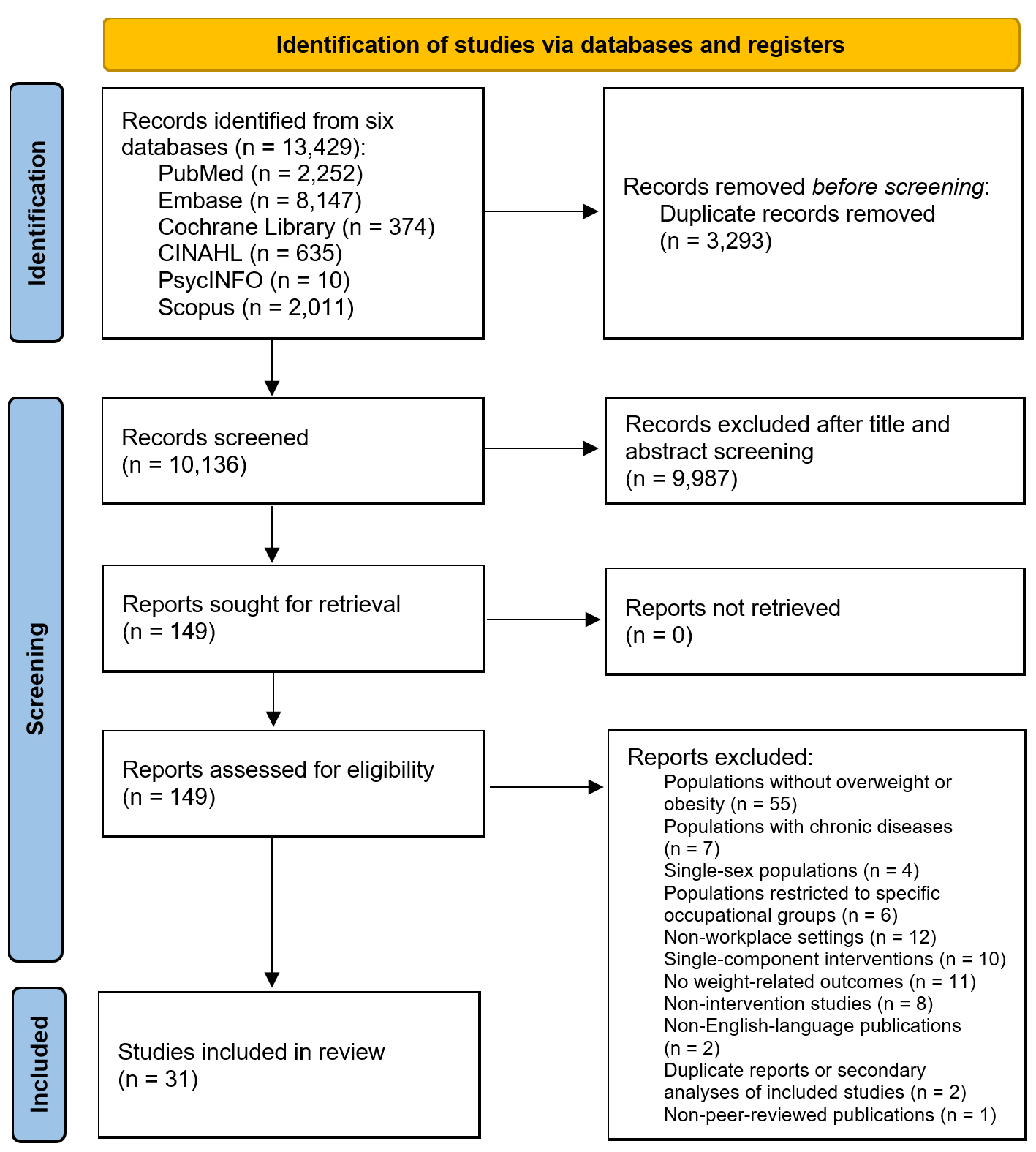
데이터베이스 검색 결과 PubMed 2,252편, Embase 8,147편, Cochrane Library 374편, CINAHL 635편, PsycINFO 10편, Scopus 2,011편으로 총 13,429편이 검색되었다. 이 중 중복문헌 3,293편을 제외한 10,136편을 대상으로 두 명의 연구자가 문헌 선정기준과 배제기준에 따라 제목과 초록을 독립적으로 검토하였다. 두 연구자가 1차 검토를 통해 선정된 149편의 전문을 독립적으로 검토하였다. 전문 검토 결과 선정기준을 충족하지 않은 118편을 배제하고, 최종적으로 31편을 포함하였다(Figure 1). 문헌 선정 과정에서 두 연구자의 판단이 일치하지 않은 경우 참여 연구자 전체가 해당 문헌을 재검토하고 논의하여 합의에 도달하였다.
2.2.4 자료추출 및 분석
최종 선정된 31편에서 구조화된 양식을 이용하여 연구 및 대상자 특성, 중재 특성, 결과변수와 평가 특성을 추출하였다. 연구 및 대상자 특성으로 출판연도, 국가, 연구설계, 표본 수, 사업장 유형과 과체중 또는 비만 선정기준을 추출하였다. 중재 특성에는 제공자, 구성요소, 기간, 접촉 빈도, 전달 방식, 디지털 기술 활용 및 제공 형식을 포함하였다. 결과변수는 신체계측 및 비만, 심혈관대사 및 신체건강, 행동, 심리사회 및 정신건강, 직장 관련 결과로 구분하였으며, 평가 특성으로 평가 시점, 중재 종료 후 최장 추적기간 및 측정방법을 추출하였다. 한 연구자가 자료를 추출하고 다른 연구자가 원문과 대조하여 검토하였으며, 불일치는 논의를 통해 합의하였다.
추출된 자료는 빈도와 백분율로 분석하였고, 복수 항목에 해당할 수 있는 변수는 복수 응답으로 처리하였다. 연구 유지율·완료율은 산출 가능한 연구를 대상으로 중앙값, 사분위범위(interquartile range, IQR) 및 범위(range)를 제시하였다. 대조군이 있는 연구는 집단 간 결과를, 단일군 연구는 중재 전후 변화를 우선으로 정리하였다. 메타분석의 적용 가능성을 검토한 결과, 무작위대조연구에서도 비교조건과 추정하고자 하는 중재효과가 상이하였다. 일부 연구는 중재와 일반관리 또는 지연중재를 비교하였으나, 다른 연구는 서로 다른 다요소 체중관리 중재를 비교하거나 기존 체중관리 중재에 특정 구성요소를 추가한 효과를 평가하였으며, 체중감량 후 유지단계의 전달방식을 비교한 연구도 포함되었다. 또한 일부 연구에서는 체중의 군 간 효과크기 산출에 필요한 자료가 보고되지 않았고, 군집 또는 다중 중재군 설계를 적용한 연구가 포함되어 있었다. 연구 간 동일한 결과변수의 측정 여부만으로 효과크기를 통합할 경우 서로 다른 중재의 비교 효과를 하나의 효과로 해석하게 될 가능성이 있다고 판단하여, 메타분석을 시행하지 않고 결과를 서술적으로 종합하였다.
2.2.5 문헌의 질 평가
최종 선정된 31편은 Joanna Briggs Institute (JBI)의 연구설계별 비판적 평가도구를 사용하여 평가하였다. 무작위대조연구는 13개 항목의 JBI 무작위대조연구 평가도구를 적용하였고(Barker et al., 2023), 유사실험연구와 단일군 전후비교 연구는 9개 항목의 JBI 유사실험연구 평가도구를 적용하였다(Barker et al., 2024). 혼합연구는 양적 및 질적 부분을 구분하여 해당 설계에 적합한 도구를 적용하였다. 각 항목은 ‘예’, ‘아니요’, ‘불확실’ 또는 ‘해당 없음’으로 평가하였다. 한 연구자가 평가하고 다른 연구자가 원문과 대조하였으며, 불일치는 논의를 통해 합의하였다.
3. 연구결과
3.1. 연구 및 대상자 관련 특성
최종 포함된 31편 중 2015년과 2019년에 출판된 연구가 각각 6편(19.4%)으로 가장 많았으며, 미국에서 수행된 연구가 17편(54.8%)이었고, 대륙별로는 북아메리카가 17편(54.8%)으로 가장 많았으며, 아시아 7편(22.6%), 유럽 6편(19.4%), 아프리카 1편(3.2%) 순이었다. 연구설계는 무작위대조연구 14편(45.2%)과 단일군 전후비교연구 13편(41.9%)이 대부분이었고, 표본 수가 100명 이하인 연구가 15편(48.4%)이었다. 기업 사업장에서 시행된 연구가 12편(38.7%)으로 가장 많았으며, 대상자 선정기준으로 체질량지수를 사용한 연구가 26편(83.9%)이었다(Table 1).
Table 1
Study- and Participant-Related Characteristics of the Included Studies (N=31)
| Characteristics | Categories | n | % | Reference Number |
|
Publication year | 2015 | 6 | 19.4 | A1–A6 |
| 2016 | 5 | 16.1 | A7–A11 | |
| 2017 | 3 | 9.7 | A12–A14 | |
| 2018 | 2 | 6.5 | A15, A16 | |
| 2019 | 6 | 19.4 | A17–A22 | |
| 2020 | 2 | 6.5 | A23, A24 | |
| 2021 | 4 | 12.9 | A25–A28 | |
| 2022 | 0 | 0.0 | — | |
| 2023 | 1 | 3.2 | A29 | |
| 2024 | 2 | 6.5 | A30, A31 | |
| Continent | North America | 17 | 54.8 | A3–A5, A7, A9–A11, A13, A15, A17, A19, A24–A29 |
| Asia | 7 | 22.6 | A1, A6, A8, A14, A18, A20, A23 | |
| Europe | 6 | 19.4 | A2, A12, A16, A21, A22, A30 | |
| Africa | 1 | 3.2 | A31 | |
| Study design | Randomized controlled trial | 14 | 45.2 | A1, A3, A5, A7, A8, A11, A13–A18, A21, A28 |
| Controlled quasi-experimental study | 3 | 9.7 | A2, A23, A29 | |
| Single-group before-and-after study | 13 | 41.9 | A4, A6, A9, A10, A12, A19, A20, A22, A24–A27, A30 | |
| Mixed methods study | 1 | 3.2 | A31 | |
| Sample size* | ≤ 100 | 15 | 48.4 | A4, A5, A7, A9, A13, A17–A20, A23–A26, A28, A30 |
| 101–200 | 5 | 16.1 | A8, A16, A21, A22, A31 | |
| 201–300 | 6 | 19.4 | A2, A6, A10, A14, A15, A29 | |
| ≥ 301 | 5 | 16.1 | A1, A3, A11, A12, A27 | |
| Worksite type | Corporate workplace | 12 | 38.7 | A6, A7, A11, A14, A16–A18, A20–A22, A27, A28 |
| Educational institution | 7 | 22.6 | A4, A8, A9, A19, A25, A29, A31 | |
| Medical institution | 3 | 9.7 | A5, A13, A24 | |
| Other organization | 4 | 12.9 | A2, A10, A12, A23 | |
| Government agency | 1 | 3.2 | A1 | |
| Multiple worksite types | 3 | 9.7 | A3, A15, A26 | |
| Not reported | 1 | 3.2 | A30 | |
|
Obesity eligibility criterion | Body mass index | 26 | 83.9 | A1–A3, A5–A17, A19, A20, A22, A24–A27, A29–A31 |
| Waist circumference | 1 | 3.2 | A28 | |
| Body mass index and/or waist circumference | 4 | 12.9 | A4, A18, A21, A23 |
3.2. 포함 문헌의 질 평가
무작위대조연구 14편에서 모든 연구가 결과를 동일한 방법으로 측정하고 신뢰성 있게 평가하였고, 관심 중재 외의 처치를 동일하게 제공한 연구는 12편(85.7%)이었다. 중재 시작 시 동질성, 추적관찰 및 탈락 처리, 적절한 통계분석과 연구설계를 충족한 연구는 각각 10편(71.4%)이었다. 적절한 무작위배정 방법을 사용한 연구와 무작위배정군에 따라 분석한 연구는 각각 7편(50.0%)이었으며, 배정은폐는 6편(42.9%), 결과평가자 맹검은 4편(28.6%)에서 확인되었다. 대상자와 중재 제공자 맹검은 모든 연구에서 이루어지지 않았다.
대조군이 있는 유사실험연구 3편은 시간적 선행성, 대조군의 존재, 비교집단 및 처치의 유사성, 동일한 결과측정 방법을 모두 충족하였다(100.0%). 신뢰성 있는 결과측정과 적절한 통계분석은 각각 2편(66.7%), 추적관찰 및 탈락 처리는 1편(33.3%)에서 충족하였으며, 중재 전후 반복측정을 실시한 연구는 없었다.
단일군 전후비교연구 13편은 시간적 선행성, 비교 대상자의 유사성, 처치의 일관성, 동일한 결과측정 및 적절한 통계분석을 모두 충족하였고(100.0%), 신뢰성 있는 결과 측정은 12편(92.3%), 추적관찰 및 탈락 처리는 9편(69.2%)에서 충족하였다. 대조군을 포함하거나 중재 전후 반복측정을 실시한 연구는 없었다.
혼합연구의 양적 부분은 관심 중재 외 처치의 동일성, 동일한 측정방법 및 측정의 신뢰성에 관한 3개 항목을 충족하였으며, 8개 항목은 충족하지 못하였고 2개 항목은 불확실로 평가되었다. 질적 부분은 연구질문과 방법론의 일치, 자료수집·분석·해석, 참여자 목소리, 윤리 및 결론에 관한 7개 항목을 충족하였으나, 그 밖의 3개 항목은 충족하지 못하였다(Table 2).
Table 2
JBI Critical Appraisal Results of the Included Studies (N=31)
| JBI appraisal item |
Yes, n (%) |
No, n (%) |
Unclear, n (%) |
| Randomized controlled trials (n=14) | |||
| Q1. True randomization | 7 (50.0) | 1 (7.1) | 6 (42.9) |
| Q2. Allocation concealed | 6 (42.9) | 1 (7.1) | 7 (50.0) |
| Q3. Groups similar at baseline | 10 (71.4) | 4 (28.6) | 0 (0.0) |
| Q4. Participants blinded | 0 (0.0) | 14 (100.0) | 0 (0.0) |
| Q5. Providers blinded | 0 (0.0) | 14 (100.0) | 0 (0.0) |
| Q6. Groups treated identically apart from intervention | 12 (85.7) | 2 (14.3) | 0 (0.0) |
| Q7. Outcome assessors blinded | 4 (28.6) | 1 (7.1) | 9 (64.3) |
| Q8. Outcomes measured identically | 14 (100.0) | 0 (0.0) | 0 (0.0) |
| Q9. Outcomes measured reliably | 14 (100.0) | 0 (0.0) | 0 (0.0) |
| Q10. Follow-up complete/attrition addressed | 10 (71.4) | 2 (14.3) | 2 (14.3) |
| Q11. Analyzed in randomized groups | 7 (50.0) | 5 (35.7) | 2 (14.3) |
| Q12. Appropriate statistical analysis | 10 (71.4) | 4 (28.6) | 0 (0.0) |
| Q13. Trial design appropriate | 10 (71.4) | 4 (28.6) | 0 (0.0) |
| Controlled quasi-experimental studies (n=3) | |||
| Q1. Cause precedes effect | 3 (100.0) | 0 (0.0) | 0 (0.0) |
| Q2. Control group | 3 (100.0) | 0 (0.0) | 0 (0.0) |
| Q3. Participants similar | 3 (100.0) | 0 (0.0) | 0 (0.0) |
| Q4. Similar care apart from intervention | 3 (100.0) | 0 (0.0) | 0 (0.0) |
| Q5. Multiple pre/post measurements | 0 (0.0) | 3 (100.0) | 0 (0.0) |
| Q6. Complete follow-up/attrition addressed | 1 (33.3) | 2 (66.7) | 0 (0.0) |
| Q7. Outcomes measured consistently | 3 (100.0) | 0 (0.0) | 0 (0.0) |
| Q8. Reliable outcome measurement | 2 (66.7) | 0 (0.0) | 1 (33.3) |
| Q9. Appropriate statistical analysis | 2 (66.7) | 1 (33.3) | 0 (0.0) |
| Single-group before-and-after studies (n=13) | |||
| Q1. Cause precedes effect | 13 (100.0) | 0 (0.0) | 0 (0.0) |
| Q2. Control group | 0 (0.0) | 13 (100.0) | 0 (0.0) |
| Q3. Participants similar | 13 (100.0) | 0 (0.0) | 0 (0.0) |
| Q4. Similar care apart from intervention | 13 (100.0) | 0 (0.0) | 0 (0.0) |
| Q5. Multiple pre/post measurements | 0 (0.0) | 13 (100.0) | 0 (0.0) |
| Q6. Complete follow-up/attrition addressed | 9 (69.2) | 4 (30.8) | 0 (0.0) |
| Q7. Outcomes measured consistently | 13 (100.0) | 0 (0.0) | 0 (0.0) |
| Q8. Reliable outcome measurement | 12 (92.3) | 0 (0.0) | 1 (7.7) |
| Q9. Appropriate statistical analysis | 13 (100.0) | 0 (0.0) | 0 (0.0) |
| Mixed-methods study (n=1) | |||
| Quantitative component (13-item JBI RCT tool) | 3/13 (23.1) | 8/13 (61.5) | 2/13 (15.4) |
| Qualitative component (10-item JBI qualitative tool) | 7/10 (70.0) | 3/10 (30.0) | 0/10 (0.0) |
3.3. 중재 관련 특성
본 분석에 포함된 중재 관련 특성은 Table 3과 같다. 중재 제공자는 영양사 또는 영양전문가가 13편(41.9%)으로 가장 많았으며, 운동 또는 신체활동 전문가가 10편(32.3%)이었다. 생활습관 및 행동 변화 지원 인력과 기타 훈련된 중재 제공자가 참여한 연구는 각각 9편(29.0%)이었다. 간호사는 6편(19.4%), 의사는 4편(12.9%)에서 중재를 제공하였다. 한편, 2편(6.5%)에서는 중재 제공자가 보고되지 않았으며, 1편(3.2%)은 직접적인 인적 제공자 없이 디지털 방식으로 중재가 제공되었다.
Table 3
Intervention-Related Characteristics of the Included Studies (N=31)
| No |
Author (year) | Intervention provider |
Intervention components | Duration |
Contact frequency |
Delivery mode and format | Digital technology type |
| A1 | Abdi et al. (2015) | Counselor | PA; NU; BS; CC | 6 months | Every 2 weeks |
Remote only; individual | Digital messaging; Telephone/video telehealth; Web/online platform |
| A2 | Barber et al. (2015) | Trained Slimming World consultant | PA; NU; BS; CC; OE | 12 weeks | Weekly |
Face-to-face only; group | N/A |
| A3 | Østbye et al. (2015) | Registered dietitian health coach; exercise physiologist; nutritionist | PA; NU; BS; CC; OE | 12 months |
Monthly or less frequent |
Hybrid/mixed; individual | Digital messaging; Telephone/video telehealth; Web/online platform |
| A4 | Radler et al. (2015) | Registered dietitian | PA; NU; BS; CC | 12 weeks | Weekly |
Hybrid/mixed; individual | Digital messaging; Telephone/video telehealth; Web/online platform |
| A5 | Stites et al. (2015) | Study team member experienced in mindful-eating training; research manager; weBSite administrator | NU; BS; PM; OE | 8 weeks |
No recurring contact | Hybrid/mixed; group | Digital messaging; Web/online platform |
| A6 | Vasquez et al. (2015) | Trainers; nutritionist | PA; NU; BS; CC; OE | 12 weeks |
≥2 contacts/ week | Hybrid/mixed; group | Digital media; Web/online platform |
| A7 | Carr et al. (2016) | Staff member trained by a certified ergonomist | PA; BS; CC; PM; OE | 16 weeks |
≥2 contacts/ week |
Hybrid/mixed; individual | Digital messaging; Mobile application; Wearable/connected device |
| A8 | Jamal et al. (2016) | Dietitian; exercise specialist; psychologist | PA; NU; BS; CC; PM | 24 weeks (6 months) |
Variable/ multiphase |
Face-to-face only; group | N/A |
| A9 | Sutliffe et al. (2016) | Research team | NU; BS; CC; OE | 6 weeks |
≥2 contacts/ week | Hybrid/mixed; group | Digital media; Digital messaging; Web/online platform |
| A10 | Townsend et al. (2016) | Trained internal worksite peer facilitators; trained external facilitators | PA; NU; BS; CC; PM | 3 months (12 weeks) |
Variable/ multiphase |
Face-to-face only; group | N/A |
| A11 | Zoellner et al. (2016) | Provider of group resource sessions not reported | PA; NU; BS; OE | 12 months |
Variable/ multiphase |
Hybrid/mixed; varied by intervention arm | Digital messaging; Web/online platform |
| A12 | Bennett et al. (2017) | Volunteer co-worker peer champions | PA; NU; BS; OE | 12 weeks | Weekly | Hybrid/mixed; group | Digital media; Digital messaging |
| A13 | Faghri et al. (2017) | Provider of personalized weight-loss consultation not reported | PA; NU; BS; CC; OE | 16 weeks |
No recurring contact |
Face-to-face only; individual | N/A |
| A14 | Shrivastava et al. (2017) | Physicians; nutritionist; physical trainer | PA; NU; BS; CC; PM | 6 months | Every 2 weeks |
Hybrid/mixed; individual and group | Digital messaging; Telephone/video telehealth; Web/online platform |
| A15 | Ing et al. (2018) | Trained peer facilitators, primarily worksite employees | PA; NU; BS; CC; PM | 9 months |
Variable/ multiphase |
Hybrid/mixed; varied by intervention arm | Digital media |
| A16 | Kempf et al. (2018) | Trained telemedical coaches | PA; NU; BS; CC; PM | 12 weeks | Weekly |
Remote only; individual | Telephone/video telehealth; Wearable/connected device; Web/online platform |
| A17 | Carpenter et al. (2019) | Health coaches; registered dietitians | PA; NU; BS; CC; PM | 6 months |
Variable/ multiphase |
Remote only; individual | Digital messaging; Telephone/video telehealth; Wearable/connected device; Web/online platform |
| A18 | Fang et al. (2019) | Physician; dietitian; nurse; athletic coach | PA; NU; BS; CC | 12 weeks |
≥2 contacts/ week |
Face-to-face only; individual | N/A |
| A19 | Gillis (2019) | University faculty/staff/students; dietetic interns and university dietitian; exercise-science personnel; nutritionist | PA; NU; BS; CC; PM; OE | 12 weeks | Weekly |
Face-to-face only; group | N/A |
| A20 | Han et al. (2019) | Nurses; nutritionists; exercise trainers/supervisor | PA; NU; BS; CC; OE | 12 weeks | Weekly |
Hybrid/mixed; individual and group | Mobile application; Wearable/connected device |
| A21 | Kempf et al. (2019) | Diabetes nurses trained in coaching; study physician did not deliver coaching | PA; NU; BS; CC; PM | 12 months |
Variable/ multiphase |
Remote only; individual | Telephone/video telehealth; Wearable/connected device; Web/online platform |
| A22 | San Mauro Martin et al. (2019) | Doctors; nurses; dietitians-nutritionists | NU; BS; CC; OE | 12 weeks | Every 2 weeks |
Hybrid/mixed; individual | Digital messaging |
| A23 | Takeyama et al. (2020) | Health educator from the insurer; health instructors | PA; NU; BS; CC | 6 months | Weekly |
Hybrid/mixed; individual | Digital messaging; Mobile application; Telephone/video telehealth; Wearable/ connected device; Web/online platform |
| A24 | Murakami et al. (2020) | Two master's-level graduate students serving as group leaders | PA; NU; BS; CC; PM | 6 months | Weekly |
Face-to-face only; group | N/A |
| A25 | Mack (2021) | Family nurse practitioner; registered nurse assistant | PA; NU; BS; CC; PM | 6 weeks |
≥2 contacts/ week | Hybrid/mixed; group | Digital messaging |
| A26 | Nepper et al. (2021) | Nurse practitioner; registered dietitians; exercise specialists; other guest speakers/chefs | PA; NU; BS; CC; PM | 16 weeks |
≥2 contacts/ week |
Hybrid/mixed; individual and group | Digital messaging; Telephone/video telehealth |
| A27 | Johnson et al. (2021) | Nationally certified health coaches | PA; NU; BS; CC; PM; OE | 6 months |
Monthly or less frequent |
Remote only; individual | Mobile application; Telephone/video telehealth; Web/online platform |
| A28 | Dorling et al. (2021) | Interventionists with kinesiology or psychology backgrounds | PA; BS; CC; OE | 3 months |
Variable/ multiphase |
Hybrid/mixed; individual and group | Telephone/video telehealth; Wearable/connected device; Web/online platform |
| A29 | Lee et al. (2023) | No direct human provider identified | PA; NU; BS; OE | 6 months | Weekly |
Remote only; self-directed | Digital media; Digital messaging; Wearable/connected device |
| A30 | Bernardelli et al. (2024) | Multidisciplinary team: physicians, physiotherapists, dietitians, and psychologists | PA; NU; BS; CC | 1–3 months |
No recurring contact |
Face-to-face only; individual | N/A |
| A31 | Hoosen et al. (2024) | Registered dietitian | PA; NU; BS; PM | 16 weeks |
≥2 contacts/ week |
Hybrid/mixed; self-directed | Digital messaging |
중재 구성요소 중 행동·자기관리는 모든 연구에 포함되었고(100.0%), 영양 29편(93.5%), 신체활동 28편(90.3%), 상담·코칭 26편(83.9%), 심리·정신건강과 조직·환경적 지원은 각각 15편(48.4%)이었다. 행동·자기관리 요소는 목표 설정, 자기모니터링, 개별 피드백, 행동계획, 문제해결, 동기 강화, 자기효능감 증진, 보상, 사회적 지지 및 집단 경쟁 등으로 구성되었다[A1, A3, A8, A13, A17, A20, A24, A25]. 체중·식사·신체활동 기록, 활동량계와 모바일 애플리케이션을 활용한 모니터링, 생체측정 결과와 건강나이에 대한 피드백도 활용되었다[A3, A16, A20, A21, A23, A29]. 영양 요소에는 건강한 식사와 식품 선택에 관한 교육, 열량과 섭취량 조절, 개별 식단과 식이상담, 지중해식 또는 식물성 식단, 식사계획과 조리교육이 포함되었으며[A9, A14, A17, A22, A24, A26, A30], 구내식당의 건강식 선택 촉진과 점심 사전 주문 등의 전략도 적용되었다[A5, A20].
신체활동 요소에는 신체활동 교육, 개인별 운동 처방, 집단운동, 걷기와 걸음 수 증진, 활동 목표 설정 및 모니터링이 포함되었다[A6, A7, A14, A18, A20, A25, A26, A28, A29]. 일부 연구에서는 좌식시간 감소를 위해 활동 휴식과 자세 변경을 권장하거나 페달 데스크와 활동형 워크스테이션을 제공하였다[A7, A28]. 상담·코칭 요소는 전문가 또는 훈련된 제공자가 대면, 전화 또는 온라인으로 실시한 개별·집단 상담, 생활습관 코칭, 동기강화면담, 맞춤형 건강지도 및 문제해결 활동으로 구성되었다[A1, A3, A10, A16, A17, A21, A23, A26, A31].
심리·정신건강 요소에는 마음챙김과 마음챙김 식사, 정서적 섭식과 폭식 관리, 스트레스 감소, 인지적 재구조화, 우울·불안 관리, 수면교육 및 심리적 동기 증진이 포함되었다[A1, A5, A8, A13, A17, A25, A26]. 조직·환경적 지원에는 구내식당의 건강한 식품환경 조성, 운동시설과 활동형 업무장비 제공, 사업장 자원 및 건강증진 프로그램과의 연계, 할인·현금·상품 등의 재정적 인센티브가 포함되었다 [A3, A5, A7, A11, A13, A20, A28, A29].
모든 연구가 4개 이상의 중재 구성요소를 포함하였다. 5개 요소로 구성된 중재가 16편(51.6%)으로 가장 많았으며, 4개 요소로 구성된 중재는 13편(41.9%), 6개 요소를 모두 포함한 중재는 2편(6.5%)이었다. 가장 빈번한 중재 구성은 신체활동, 영양, 행동·자기관리, 심리·정신건강 및 상담·코칭을 결합한 형태로 10편(32.3%)이었다. 신체활동, 영양, 행동·자기관리 및 상담·코칭의 조합과 여기에 조직·환경적 지원을 추가한 조합은 각각 5편(16.1%)이었다.
중재 기간은 3개월 이하가 15편(48.4%), 4–6개월이 12편(38.7%), 6개월 초과가 4편(12.9%)이었다. 중재 기간의 중앙값은 4.0개월(IQR 3.0–6.0개월)이었으며, 범위는 1.5–12.0개월이었다.
중재 제공 빈도는 주 1회인 연구가 9편(29.0%)으로 가장 많았고, 주 2회 이상 중재를 제공한 연구가 7편(22.6%)이었다. 주 1회 이상 정기적으로 중재를 제공한 연구는 총 16편(51.6%)으로 전체 연구의 절반 이상을 차지하였다. 중재 단계에 따라 제공 빈도가 변화하거나 연구군별로 서로 다른 빈도가 적용된 가변적·다단계 중재는 7편(22.6%)이었다. 2주마다 중재를 제공한 연구는 3편(9.7%), 월 1회 이하로 제공한 연구는 2편(6.5%)이었으며, 초기 중재 제공 이후 반복적인 중재 제공이 없었던 연구는 3편(9.7%)이었다.
중재 전달 방식은 대면과 원격 또는 디지털 방식을 함께 활용하거나 연구군별로 서로 다른 전달 방식을 적용한 혼합형 중재가 17편(54.8%)으로 가장 많았다. 대면 방식으로만 중재를 제공한 연구는 8편(25.8%)이었으며, 전화, 웹, 디지털 매체 또는 웨어러블 기기 등을 통해 원격으로만 중재를 제공한 연구는 6편(19.4%)이었다. 전체 연구 중 중재 전달, 상담·코칭, 자기 모니터링 또는 피드백을 위해 디지털 기술을 활용한 연구는 23편(74.2%)이었다. 구체적으로 이메일, 문자메시지 및 소셜미디어와 같은 디지털 메시지가 16편(51.6%)으로 가장 많았고, 웹사이트와 온라인 포털 등의 웹 기반 플랫폼이 14편(45.2%), 전화 또는 화상 기반 원격의료가 11편(35.5%)이었다. 활동량계, 스마트워치 및 연결형 체중계 등의 웨어러블·연결형 기기는 8편(25.8%), DVD와 동영상 등의 디지털 매체는 5편(16.1%), 모바일 애플리케이션은 4편(12.9%)에서 활용되었다.
중재 제공 형식은 개인 단위 중재가 13편(41.9%)으로 가장 많았으며, 집단 단위 중재가 10편(32.3%)이었다. 개인과 집단 형식을 함께 적용한 연구는 4편(12.9%)이었다. 대상자가 중재를 독립적으로 수행한 자기주도형 중재는 2편(6.5%)이었으며, 연구군에 따라 서로 다른 제공 형식을 적용한 연구도 2편(6.5%)이었다.
연구 유지·완료율은 29편(93.5%)에서 산출할 수 있었으며, 중앙값은 88.1%(IQR 77.8–92.3%, range 53.2–100.0%)였다. 중재 과정 참여도를 정량적으로 보고한 연구는 12편(38.7%)이었으나, 세션 참석, 코칭 완료, 앱 또는 기기 사용, 자기 모니터링 순응도 등 측정 지표와 분모가 상이하여 통합 값은 산출하지 않았다. 일부 연구에서는 중재 만족도, 프로그램 평가, 디지털 기기 또는 애플리케이션 사용 및 중재 순응도와 같은 실행·과정 지표를 보고하였다.
3.4. 결과변수 및 평가 관련 특성
본 분석에 포함된 결과변수 및 평가 관련 특성은 Table 4와 같으며, 각 항목은 복수응답으로 분석하였다. 신체계측 및 비만 관련 결과는 31편 모두에서 보고되었다. 체중 또는 체중변화가 30편(96.8%)으로 가장 많이 평가되었고, 체질량지수 24편(77.4%), 허리둘레, 엉덩이둘레 또는 허리-엉덩이둘레비 등의 중심성 비만 지표 17편(54.8%), 체지방률, 지방량, 제지방량, 피부두겹두께 및 내장지방 등의 신체구성 지표 9편(29.0%) 순이었다. 심혈관대사 및 신체건강 관련 결과는 20편(64.5%)에서 보고되었으며, 혈압이 17편(54.8%)으로 가장 많았다. 지질과 혈당 지표 및 간·신장·염증 관련 수치를 포함한 혈액 생화학 지표는 13편(41.9%), 보행검사, 체력지수, 유연성, 근력·근지구력 및 기능제한 등의 체력·기능 지표는 5편(16.1%), 심박수, 평균동맥압 또는 심혈관질환 위험도는 3편(9.7%)에서 평가되었다. 수면과 근골격계 증상은 각각 1편(3.2%)에서 보고되었다.
Table 4
Outcome- and Assessment-Related Characteristics of the Included Studies (N=31)
| No |
Author (year) |
Anthropometric/ obesity outcomes |
Cardiometabolic/ physical health outcomes | Behavioral/psychosocial outcomes |
Workplace outcomes | Assessment time points |
Measurement methods |
| A1 | Abdi et al. (2015) | BW; WC/HC/WHR | BP | Behavioral: Behavioral determinants | — | BL; M6 PIFU; M9 PI maintenance | OA; OC; SR |
| A2 | Barber et al. (2015) | BW; BMI | — | Behavioral: DI/EB; Psychosocial: Self-esteem/emotional well-being | — | BL; W12 (EOI); M6 and M12 from BL | OA; SR |
| A3 | Østbye et al. (2015) | BW; BMI | — | Behavioral: PA/SB; DI/EB; Behavioral determinants | — | BL; approximately M14 (author-designated immediate PI) | OA; DA; SR |
| A4 | Radler et al. (2015) | BW; BMI; WC/HC/WHR; BC | BP; LP; GM; HR/MAP/CVD risk | Behavioral: PA/SB; Psychosocial: QoLI | — | BL; W10–14 (EOI of 12-week intervention) | OA; OC; SR |
| A5 | Stites et al. (2015) | BW; BMI | LP; GM | Behavioral: DI/EB | — | Daily assessments across BL, full-intervention, and reduced-intervention phases; other outcomes at BL and W15 | OA; OC; SR; AR |
| A6 | Vasquez et al. (2015) | BW; BMI; BC | PF/FC | Behavioral: PA/SB; DI/EB; Behavioral determinants | — | BL/W1; W6 (fitness assessment); W12 (EOI) | OA; OC; SR |
| A7 | Carr et al. (2016) | BW; WC/HC/WHR; BC | BP; HR/MAP/CVD risk; MSK symptoms | Behavioral: PA/SB |
Work productivity or performance | BL; W16 PI | OA; OC; DA; SR |
| A8 | Jamal et al. (2016) | BW; BMI; WC/HC/WHR | BP; LP; GM | Behavioral: PA/SB; DI/EB; Behavioral determinants; Psychosocial: QoLI; Social/family support; Negative thoughts | — | BL; W12 (during intervention); W24 (EOI); W36 FU | OA; OC; SR |
| A9 | Sutliffe et al. (2016) | BW; BMI; WC/HC/WHR | BP; LP; GM | Behavioral: PA/SB; DI/EB | — | 1 week preintervention; 1 week after EOI of the 6-week intervention | OA; OC; DA; SR |
| A10 | Townsend et al. (2016) | BW; BMI | BP; PF/FC | Behavioral: PA/SB; DI/EB; Behavioral determinants; Psychosocial: Social/family support | — | BL within 2 weeks preintervention; M3 within 2 weeks after EOI | OA; OC; SR |
| A11 | Zoellner et al. (2016) | BW | — | — | — | BL; M12 (EOI) | OA |
| A12 | Bennett et al. (2017) | BW; BMI | — | — | — | Enrollment/BL; W12 (final assessment) | OA |
| A13 | Faghri et al. (2017) | BW; BMI | — | Behavioral: PA/SB; DI/EB; Behavioral determinants | — | BL/W1; W16 (EOI); W28 FU | OA; SR |
| A14 | Shrivastava et al. (2017) | BW; BMI; WC/HC/WHR; BC | BP; LP; GM | Behavioral: PA/SB; DI/EB | — | BL; M6 (EOI) | OA; OC; SR |
| A15 | Ing et al. (2018) | BW; BMI | BP; PF/FC | Behavioral: PA/SB; DI/EB; Behavioral determinants; Psychosocial: Social/family support | — | M3 (randomization/start of 9-month maintenance phase); M12 PI | OA; OC; SR |
| A16 | Kempf et al. (2018) | BW; BMI; WC/HC/WHR | BP; LP; GM | — | — | BL; W12 (EOI); W52 FU | OA; OC; DA; DR |
| A17 | Carpenter et al. (2019) | BW | — | Behavioral: DI/EB; Psychosocial: Depression; Anxiety; Perceived stress; Mindfulness/acceptance | — | BL; M6 (EOI) | OA; SR |
| A18 | Fang et al. (2019) | BW; BMI; WC/HC/WHR; BC | BP; LP; GM; PF/FC; HR/MAP/CVD risk | Psychosocial: QoLI |
Occupational stress; Job satisfaction | BL; W12 (EOI) | OA; OC; SR |
| A19 | Gillis (2019) | BW; BMI; WC/HC/WHR; BC | BP | — | — | BL; W6 (mid-intervention); W12 PI | OA; OC |
| A20 | Han et al. (2019) | BW; BMI; WC/HC/WHR; BC | BP; LP; GM; OBM | — | — | BL; W12 (EOI) | OA; OC |
| A21 | Kempf et al. (2019) | BW; WC/HC/WHR | BP; LP; GM; OBM | Behavioral: PA/SB; DI/EB; Psychosocial: QoLI | — | BL; M3, M6, and M9 (during intervention); M12 (EOI); M36 FU | OA; OC; DA; SR; DR |
| A22 | San Mauro Martin et al. (2019) | BW; BMI; WC/HC/WHR; BC | — | — | — | BL; W12 (EOI) | OA |
| A23 | Takeyama et al. (2020) | BMI; WC/HC/WHR | BP; LP; GM | Behavioral: PA/SB | — | BL; M6 (EOI) | OA; OC; DA; DR |
| A24 | Murakami et al. (2020) | BW; BMI; WC/HC/WHR | BP; LP; GM | Behavioral: PA/SB; DI/EB; Psychosocial: QoLI; Social/family support | — | BL/S1; every fourth session (partial assessment); S20 (EOT) | OA; OC; SR |
| A25 | Mack (2021) | BW; WC/HC/WHR | — | Behavioral: PA/SB; Behavioral determinants | — | W1 (BL); W6 postprogram | OA; SR |
| A26 | Nepper et al. (2021) | BW; BMI | BP; LP; GM; Sleep | Behavioral: PA/SB; DI/EB; Psychosocial: Depression | — | BL; W16 (EOI); 3–6 months PIFU | OA; OC; SR; AR |
| A27 | Johnson et al. (2021) | BW; BMI | — | — | — | BL; W26 final assessment | OA |
| A28 | Dorling et al. (2021) | BW; BMI; WC/HC/WHR; BC | BP; LP; GM | Behavioral: PA/SB; DI/EB | — | BL; M3 (EOI) | OA; OC; DA; SR; DR |
| A29 | Lee et al. (2023) | BW | — | Behavioral: PA/SB; DI/EB | — | BL; M6 (EOI) | OA; SR; DR |
| A30 | Bernardelli et al. (2024) | BW; BMI; WC/HC/WHR | PF/FC | Behavioral: PA/SB; Psychosocial: QoLI | — | BL/T0; T1 at EOT approximately 1–3 months later | OA; OC; SR |
| A31 | Hoosen et al. (2024) | BW; BMI | — | Behavioral: PA/SB; DI/EB; Behavioral determinants | — | BL; W16 (EOI) | OA; SR |
행동 관련 결과는 23편(74.2%)에서 보고되었다. 신체활동 및 좌식행동을 평가한 연구가 19편(61.3%)으로 가장 많았으며, 운동 빈도와 시간, 중·고강도 신체활동, 걸음 수, 활동량, 에너지소비량 및 좌식시간 등이 포함되었다. 식이섭취 및 식행동은 17편(54.8%)에서 평가되었고, 식이섭취량과 식사의 질, 식이지침 준수도, 지방섭취량, 식품섭취 빈도, 점심 구매행동, 마음챙김 식사, 정서적 섭식 및 폭식행동 등이 포함되었다. 자기효능감, 변화 준비도, 목표와 행동계획, 행동의도 및 사회인지적 요인 등의 행동변화 결정요인은 9편(29.0%)에서 평가되었다. 심리사회적 및 정신건강 관련 결과는 11편(35.5%)에서 보고되었으며, 삶의 질 6편(19.4%), 사회적 또는 가족 지지 4편(12.9%), 우울·불안·지각된 스트레스 2편(6.5%), 마음챙김, 수용, 심리적 유연성, 경험회피 및 부정적 사고 등의 인지·정서적 결과 2편(6.5%), 자아존중감과 정서적 건강 1편(3.2%)이었다. 직장 관련 결과는 2편(6.5%)에서만 평가되었으며, 업무생산성 또는 수행능력, 건강 관련 결근과 업무집중도, 직무스트레스 및 직무만족도가 포함되었다.
평가시점의 경우 모든 연구에서 중재 전 기초평가를 시행하였고, 30편(96.8%)은 중재 종료시점 또는 즉시 사후에 결과를 평가하였다. 중재 진행 중 평가를 시행한 연구는 6편(19.4%)으로, 중재 6주 또는 12주 시점의 신체계측·체력평가, 중재 3·6·9개월 시점의 체중평가 및 일정 회기마다 시행한 부분평가가 포함되었다. 중재 종료 후 유지 또는 장기효과를 평가하기 위한 추적관찰은 7편(22.6%)에서 시행되었다. 최장 추적기간은 중재 종료 후 6개월 이하와 7–12개월이 각각 3편(9.7%)이었고, 12개월을 초과한 연구는 1편(3.2%)이었다.
결과변수 측정방법은 객관적 신체계측 또는 신체구성 측정이 31편(100.0%) 모두에서 사용되었으며, 체중계, 신장계, 줄자, 생체전기저항분석, 컴퓨터단층촬영 및 자기공명영상 등이 활용되었다. 자기보고식 설문이나 대상자 기록은 23편(74.2%)에서 사용되어 신체활동, 식이섭취, 삶의 질, 정신건강 및 행동변화 관련 요인을 평가하였다. 혈압·심박수, 혈액 생화학검사, 보행검사, 체력검사 및 기능평가 등의 객관적 임상·기능 측정은 20편(64.5%), 가속도계, 만보기 및 활동량계 등을 이용한 기기 기반 활동 측정은 7편(22.6%)에서 시행되었다. 온라인 포털, 모바일 애플리케이션, 원격전송형 기기 및 연결형 체중계의 디지털 기록은 5편(16.1%), 구내식당 구매자료나 직원 건강검진 자료 등의 행정·임상·직장 기록은 2편(6.5%)에서 활용되었다.
3.5. 주요 중재 결과
포함 연구는 연구설계, 중재내용, 결과변수 및 효과보고 방식이 이질적이어서 메타분석을 시행하지 않고 주요 결과를 서술적으로 종합하였다(Table 5). 신체계측 및 비만 관련 결과를 연구설계에 따라 살펴보면, 무작위대조연구에서 체중 및 비만 관련 결과는 연구에 따라 상이하였다. 일부 연구에서는 대조군보다 체중감량 또는 임상적으로 의미 있는 체중감량 달성에서 유의한 차이가 보고되었으나[A8, A14, A16], 서로 다른 중재 또는 전달방식을 비교한 연구에서는 체중감량이나 체중유지의 집단 간 차이가 유의하지 않은 경우도 있었다[A3, A15, A17, A21]. 대조군이 있는 유사실험연구에서는 두 집단 모두 체중 또는 비만 관련 지표의 개선이 관찰되었으나 집단 간 차이는 유의하지 않거나 추가 중재의 효과가 뚜렷하지 않았다[A2, A23, A29]. 단일군 전후비교연구에서는 모든 연구에서 중재 후 체중, BMI 또는 허리둘레 중 하나 이상의 감소가 보고되었다[A4, A6, A9, A10, A12, A19, A20, A22, A24–A27, A30].
Table 5
Main Findings of the Included Studies (N=31)
| No | Author (year) | Main findings |
| A1 | Abdi et al. (2015) | The telephone- and web-assisted groups lost 1.92 and 1.08 kg, respectively, and the weight reductions remained stable at the 9-month maintenance assessment. Self-efficacy and outcome expectancies improved in both groups, with broader social-cognitive improvements in the telephone-assisted group. |
| A2 | Barber et al. (2015) | Completers lost a mean 4.9 kg (5.7%) during the 12-week program. Mental/emotional health and self-worth improved, with improvements in self-worth and dietary habits sustained through 12 months and physical-activity habits through 6 months. No significant differences were observed between workplace and community delivery. |
| A3 | Østbye et al. (2015) | No clinically or statistically meaningful differences were found between WM+ and WM. Both arms showed modest BMI reductions and favorable changes in diet and physical activity. |
| A4 | Radler et al. (2015) | Among participants completing the 12-week assessment, weight, waist circumference, and several cardiometabolic risk factors improved significantly. |
| A5 | Stites et al. (2015) | The intervention reduced the energy and fat content of purchased lunches relative to delayed controls; reductions persisted during the reduced-intervention phase, and mindful-eating behavior improved. |
| A6 | Vasquez et al. (2015) | Mean weight, BMI, and body-fat percentage decreased by 3.58 kg, 1.32 kg/m², and 2.14%, respectively, while fitness improved. Greater session participation was associated with greater benefits. |
| A7 | Carr et al. (2016) | The integrated intervention increased occupational light-intensity activity versus health protection alone. Greater workstation use was associated with improvements in adiposity, resting heart rate, concentration, and health-related missed workdays. |
| A8 | Jamal et al. (2016) | GSLiM participants were more likely to achieve the targeted 6% weight loss than dietary-counseling participants (19.6% vs. 4.1%) and showed greater gains in self-efficacy, friend support, and quality of life; most cardiometabolic group differences were not significant. |
| A9 | Sutliffe et al. (2016) | Several anthropometric and cardiometabolic measures, including weight, BMI, waist/hip measures, blood pressure, and selected lipid and glycemic markers, improved significantly, although some lipid measures did not improve. |
| A10 | Townsend et al. (2016) | Weight, blood pressure, physical functioning, physical-activity frequency, fat intake, family support, and eating self-efficacy improved. Worksite and behavioral factors were associated with the magnitude of weight loss. |
| A11 | Zoellner et al. (2016) | Health literacy was associated with program reach and moderated weight-loss outcomes. Among employees with lower health literacy, the intensive INCENT program produced greater weight loss than the lower-intensity LMW program. |
| A12 | Bennett et al. (2017) | Mean weight loss was 1.9–2.5 kg across annual cohorts, and 21–26% achieved at least 5% weight loss. Engagement and completion were high, with men more likely to complete and achieve clinically meaningful loss. |
| A13 | Faghri et al. (2017) | Eating and exercise self-efficacy were significant mediators of the relationship between health behaviors and weight loss, while financial incentives moderated the effect of self-efficacy on weight loss. |
| A14 | Shrivastava et al. (2017) | The multicomponent intervention significantly reduced weight, BMI, waist circumference, triglycerides, and skinfold thickness and increased HDL cholesterol; more than 5% weight loss occurred more often than in controls. |
| A15 | Ing et al. (2018) | Weight loss and weight-loss maintenance did not differ between DVD and face-to-face delivery. Greater lesson attendance during the initial weight-loss phase predicted better 12-month weight outcomes. |
| A16 | Kempf et al. (2018) | Telemonitoring with coaching produced significant weight loss versus routine care at 12 months and was sustained over follow-up. Both telemedical groups improved BMI, waist circumference, and LDL cholesterol, with broader cardiometabolic gains in the coached group. |
| A17 | Carpenter et al. (2019) | Adding mindfulness was feasible and acceptable but did not improve average weight loss, engagement, or satisfaction beyond standard phone-based behavioral treatment. Mindful eating, binge eating, and experiential avoidance improved. |
| A18 | Fang et al. (2019) | The physical-activity program improved body fat, metabolic-syndrome risk factors, fitness, and lipid profiles and also produced favorable changes in work control, work relationships, job satisfaction, and quality of life. |
| A19 | Gillis (2019) | Body weight, body fat, and waist circumference decreased significantly. Class attendance showed a moderate association with greater weight loss. |
| A20 | Han et al. (2019) | Mean body weight decreased by 5.8%, with significant improvements in anthropometric measures, blood pressure, glycemic and lipid markers, liver enzymes, and visceral and subcutaneous adiposity. |
| A21 | Kempf et al. (2019) | Per-protocol analyses favored telemedical coaching at 12 months, but differences were not significant in intention-to-treat analyses. All groups sustained weight loss at 36 months, with no between-group difference at long-term follow-up. |
| A22 | San Mauro Martin et al. (2019) | All anthropometric measures decreased significantly. Overall, 77.5% met the study-defined responder criterion; women were more likely to be classified as responders, whereas men showed larger anthropometric reductions. |
| A23 | Takeyama et al. (2020) | Both Specific Health Guidance groups improved several metabolic indicators. The ICT app did not confer a major overall additional benefit, although more frequent app users tended to show greater improvements. |
| A24 | Murakami et al. (2020) | Participants achieved significant improvements in weight, BMI, and waist circumference, accompanied by physiological, behavioral, psychological, and eating-habit improvements; 78% completed treatment. |
| A25 | Mack (2021) | All completers lost weight; 89% reduced waist circumference, 53% improved physical activity, and 61% improved readiness to change. |
| A26 | Nepper et al. (2021) | Participants lost a mean 13 lb (5.6%) and improved BMI, diastolic blood pressure, glucose, physical activity, nutrition behavior, sleep, and depression. Partial weight regain occurred 3–6 months after the program. |
| A27 | Johnson et al. (2021) | Participants achieved mean weight losses of 2.5% among those with overweight and 3.6% among those with obesity. Weight loss did not differ by sex, and perceived program value was high. |
| A28 | Dorling et al. (2021) | The intervention reduced visceral adipose tissue and fasting glucose versus control, but did not significantly change steps, other cardiometabolic markers, or food intake. Pedal-desk use averaged 127 min/day. |
| A29 | Lee et al. (2023) | Both pre-COVID and COVID-era cohorts lost weight and increased moderate-to-vigorous physical activity, with no significant difference in change between cohorts. The COVID-era cohort reported less favorable dietary patterns. |
| A30 | Bernardelli et al. (2024) | Quality of life and self-reported physical activity improved, while sedentary time, weight, and BMI decreased. Six-minute walk distance also increased significantly. |
| A31 | Hoosen et al. (2024) | The program showed acceptable reach and largely successful implementation, with favorable shifts in beliefs, stages of change, and lifestyle behaviors and a favorable, hypothesis-generating signal for weight loss; scheduling and teaching-time constraints were important barriers. |
심혈관 대사 및 신체 건강 결과에서는 혈압, 혈당, 당화혈색소, 지질 지표, 내장지방 및 신체적 체력의 개선이 보고되었다[A9, A14, A18, A20, A26, A28]. 그러나 일부 연구에서는 특정 지표만 개선되거나 집단 간 차이가 나타나지 않아 심혈관 대사 결과에 대한 효과가 일관되지는 않았다[A8, A23, A28]. 행동 및 심리사회적 결과에서는 신체활동 증가, 좌식 시간 감소, 식이 섭취와 식행동 개선뿐 아니라 자기효능감, 변화 준비도, 삶의 질, 사회적 지지 및 우울 등의 개선이 보고되었다[A1, A2, A8, A10, A13, A24, A25, A26]. 마음챙김을 추가한 중재는 체중 감량의 추가 효과는 나타나지 않았으나, 마음챙김 식사와 폭식 행동 등 일부 심리·식행동 결과를 개선하였다[A17]. 직장 관련 결과를 평가한 연구는 제한적이었으나, 업무 집중도와 건강 관련 결근[A7], 직무스트레스 및 직무만족도[A18]의 개선이 보고되었다.
중재 종료 후 추적 평가를 실시한 연구는 7편이었다[A1, A2, A8, A13, A16, A21, A26]. 일부 연구에서는 중재 종료 후에도 체중 감량이 유지되었다[A1, A16, A21]. 그러나 장기 추적 시 집단 간 차이가 소실되거나[A21], 중재 종료 후 체중이 일부 재증가한 연구도 있었다[A26].
4. 논 의
본 연구는 근로자의 과체중 및 비만 관리를 위한 직장 기반 다요소 중재의 특성과 주요 결과를 파악하기 위한 체계적 문헌고찰로서, 총 31편의 논문을 분석하였다.
본 연구에 포함된 31편의 문헌 중 절반 이상이 미국에서 수행되었고, 참여 대상자가 100명 이하인 연구가 전체의 48.4%였다. 근로자의 건강행동과 프로그램 참여는 개인적 특성뿐 아니라 근무시간, 고용 형태, 산업보건 체계, 기업의 복지제도 및 조직문화의 영향을 받을 수 있다(Ding & Liu, 2023; Tsutsumi et al., 2020). 따라서 미국 중심의 연구결과를 산업구조, 근로문화 및 사업장 보건관리 체계가 다른 국가에 그대로 일반화하는 데에는 주의가 필요하다. 향후에는 다양한 국가와 산업군을 포함한 다기관 연구를 수행하고, 충분한 표본을 확보하여 성별, 연령, 직종, 근무형태 및 비만 수준에 따른 차이를 검토할 필요가 있다.
본 연구에 포함된 31편 중 14편(45.2%)이 무작위대조연구였으나, 전체 연구의 절반 이상은 비무작위 또는 단일군 설계였다. 또한 무작위대조연구에서도 무작위배정, 배정은폐, 탈락자 처리 및 결측자료 분석 등 방법론적 질이 상이하였으므로, 연구결과를 해석할 때 연구설계와 비뚤림 위험을 함께 고려해야 한다. 실제로 무작위대조연구에서도 체중 및 비만 관련 결과는 일관되지 않았으며, 이러한 차이는 단순히 방법론적 질만으로 설명되지 않았다. 질 평가에서 주요 방법론적 기준을 상대적으로 충실히 충족한 연구를 살펴보면, A16에서 원격 모니터링에 코칭을 결합한 중재가 일반관리보다 체중감량에 유의한 효과를 보인 반면, A21에서는 intention-to-treat 분석에서 집단 간 차이가 유의하지 않았고 장기 추적에서도 집단 간 차이가 나타나지 않았다. A28에서도 체중과 BMI의 집단 간 차이는 유의하지 않았으나 내장지방 감소가 확인되었다. 한편, 단일군 전후비교연구에서는 체중, BMI 및 허리둘레의 감소가 비교적 빈번하게 보고되었으나, 이러한 변화는 독립적인 대조군 없이 관찰된 전후 변화라는 점에서 무작위대조연구의 집단 간 효과와 동일하게 해석하기에는 제한이 있다. 따라서 직장 기반 다요소 체중관리 중재의 결과는 연구설계뿐 아니라 대조군, 중재의 구성과 강도 및 평가시점을 함께 고려하여 해석할 필요가 있다.
본 연구에는 일반 기업, 교육기관, 의료기관, 정부기관 및 기타 조직 등 다양한 사업장 유형이 포함되었다. 이들 기관은 조직구조, 자원, 참여자 특성, 근무 형태 및 건강증진 사업에 부여하는 우선순위에서 차이가 있을 수 있다. 일부 연구에서는 업무 일정, 근무시간 침해, 교대근무, 업무 부담 및 조직의 협조 부족이 중재 운영과 추적평가의 장애요인으로 보고되었다[A26, A29, A31]. 의료기관을 대상으로 한 연구에서는 건강전문 인력과 검사 자원을 활용할 수 있었으나, 교대근무와 높은 업무부담이 지속적인 참여를 저해할 수 있었다[A13, A26]. 직장은 근로자가 하루 중 상당한 시간을 보내며 식사, 신체활동, 좌식 행동 및 사회적 상호작용이 반복되는 주요 생활터라는 점에서 건강 증진 중재를 제공하기에 유용한 환경이다. 또한 동료 및 팀 단위 접근을 통해 사회적 지지와 상호 격려를 활용할 수 있다는 장점이 있다(Motalebi et al., 2018). 따라서 향후에는 조직지원, 관리자 태도, 근무시간 조정 및 사업장 자원과 중재 실행 및 효과 간의 관계를 체계적으로 분석할 필요가 있다.
대상자 선정기준으로는 체질량지수가 26편(83.9%)에서 가장 빈번하게 사용되었고, 결과변수로는 체중 또는 체중 변화가 30편(96.8%)에서 가장 많이 평가되었다. 체질량지수는 측정이 간편하고 비용이 적게 들며 사업장 건강검진 자료와 연계하기 쉽다는 장점으로 인해 참여 기준으로 널리 사용된 것으로 보인다[A20, A23, A31]. 그러나 체질량지수는 체지방량과 제지방량을 구분하지 못하고 지방의 분포를 충분히 반영하지 못하므로 동일한 체질량지수를 가진 근로자라도 심혈관 대사 위험에 차이가 있을 수 있다(Kim, 2015). 따라서 향후 직장 기반 체중관리 중재에서는 체질량지수와 함께 허리둘레, 허리-엉덩이둘레비 또는 체지방률을 활용하여 대상자의 비만 상태와 건강 위험을 보다 구체적으로 파악할 필요가 있다. 한편, 다수의 연구에서 신체활동, 식이 행동, 자기효능감, 스트레스, 사회적 지지 등 행동·심리지표를 포함하여 중재의 영향을 분석하였으며 일부 연구에서는 표준화된 자가 보고식 도구를 사용하였다[A3, A8]. 이러한 지표는 체중 변화만으로 확인하기 어려운 행동변화 과정과 중재의 작동 기전을 파악하는 데 유용하다. 따라서 체중 변화뿐 아니라 자기효능감, 자기조절, 변화 준비도 등의 과정지표와 업무생산성, 결근, 조직의 건강 문화 등 직장 관련 결과를 함께 평가할 필요가 있다. 향후 연구에서는 자기보고식 측정과 객관적 측정을 결합하고, 중심성 비만, 건강행동, 심리사회적 상태, 중재 참여와 순응도, 직장 관련 결과 및 장기적 유지 여부를 포함하는 통합적 평가체계를 마련해야 한다.
본 연구에 포함된 연구에서 중재 제공자는 영양전문가가 가장 많았고, 이어 신체활동 전문가와 행동·생활습관 지원 제공자 순이었다. 의료인 중에는 간호사와 의사가 중재 제공에 참여하였으나 그 비율은 상대적으로 낮았다. 과체중 또는 비만 근로자 중에는 고혈압, 이상지질혈증, 혈당이상 및 근골격계 문제를 함께 가진 대상자가 포함될 수 있으므로 건강위험 평가, 이상소견 모니터링 및 의료기관 연계를 담당할 보건의료 전문인력이 필요하다(Kim et al., 2026). 따라서 향후에는 산업간호사, 영양사, 운동전문가, 의사 및 행동변화 전문가가 역할을 분담하는 다학제적 전달체계의 효과, 실행 가능성 및 비용효율성을 검토할 필요가 있다.
중재 제공 형식으로는 대면과 비대면을 결합한 하이브리드 방식이 가장 많았으며, 전체 연구의 23편(74.2%)에서 디지털 기술이 활용되어 직장 기반 체중관리 중재에서 디지털 접근이 널리 사용되고 있음을 확인하였다. 디지털 기술은 시간과 장소의 제약을 줄이고 지속적인 자기모니터링을 지원하는데 활용될 수 있으므로(Lautenbach, Blüher, Mijuskovic, Jones, & Schirmann, 2026), 대면 지원과 디지털 기술을 결합한 유연한 중재는 근로자에게 적합한 전달 전략이 될 수 있다. 그러나 디지털 기술을 활용했다는 사실만으로 참여도나 효과가 높다고 해석하면 안 되며, 애플리케이션 로그인 빈도, 자기기록 입력률, 메시지 열람률, 웨어러블 착용시간, 원격상담 참여율 및 피드백 수신 여부를 함께 보고할 필요가 있다[A17, A20, A23]. 또한 디지털 기기 활용능력과 건강문해력의 차이는 모집과 중재 참여의 격차로 이어질 수 있으므로 대상자의 디지털 리터러시를 고려한 자료와 지원전략이 필요하다(Kim, Kang, Im, Kim, & Chang, 2026).
연구 유지·완료율을 산출할 수 있었던 29편에서 중앙값은 88.1%였으며, 사분위범위는 77.8∼92.3%, 범위는 53.2∼100.0%였다. 연구 간 유지·완료율의 차이에는 중재설계, 근무일정, 조직지원, 연구기간 및 완료기준이 영향을 미쳤을 가능성이 있다. 연구 유지·완료율은 중재의 수용성과 적용 가능성을 판단하는 중요한 과정지표이지만 세션 출석률, 중재 순응도 및 디지털 사용률과는 구분해야 한다. 연구를 완료한 대상자도 중재에 충분히 노출되지 않았을 수 있으므로, 완료율만으로 중재 참여도를 판단하기 어렵다. 따라서 향후 연구에는 연구 유지·완료율, 세션 출석률, 중재 순응도 및 디지털 사용량을 구분하여 보고하고, 실제 중재 노출량과 건강 결과의 관계를 분석할 필요가 있다. 특히 일부 연구에서는 학교 일정과 조직의 추적 방문 협조 부족으로 사업장 단위의 탈락이 발생하여, 개인의 중도 탈락으로 보이는 결과가 실제로는 조직 수준 제약에 의해 발생할 수 있음을 보여주었다[A31]. 이를 극복하기 위해서는 근무시간 내 중재 운영, 관리자와 동료의 지지, 건강문해력에 적합한 교육자료, 개인별 피드백 및 적절한 인센티브가 고려될 수 있다(Jo, Cho, Han, & Hyun, 2023; Zoellner et al., 2016).
본 연구에서는 중재 기간에 따른 결과를 직접 비교하지 않았으므로 중재 기간이 길수록 효과가 크다고 해석할 수는 없다. 단기간 중재는 초기 체중 감량, 건강행동 변화 및 실행 가능성을 평가하는 데 유용하지만, 체중 재증가와 행동 유지 여부를 판단하기에는 제한적이다[A2, A3, A26]. 실제로 중재 종료 후 추적한 의료기관 근로자 연구에서는 초기 체중 감량 이후 일부 체중 재증가가 관찰되어 유지관리의 필요성이 강조되었다[A26]. 이는 체중관리 중재에서 초기 감량뿐 아니라 유지 단계의 설계와 지속적인 접촉이 중요함을 시사한다. 따라서 초기 집중 중재 이후 접촉 빈도를 단계적으로 낮추거나 디지털 자기 모니터링과 원격지원을 지속하는 유지 단계를 검증할 필요가 있다. 또한 개인 교육과 상담뿐 아니라 건강한 식품환경, 활동 친화적 공간, 근무시간 내 참여 보장, 좌식시간 감소, 관리자 지지 및 팀 기반 활동 등 직장환경을 변화시키는 다수준 접근을 고려해야 한다. 향후 연구에서는 중재 종료 후 최소 6∼12개월의 추적 평가를 실시하여 체중 유지와 재증가 및 건강행동의 지속 여부를 확인할 필요가 있다.
본 연구에는 몇 가지 제한점이 있다. 첫째, 포함 연구 간 연구설계, 중재 구성과 기간, 대상자 특성 및 결과보고 방식에 이질성이 있었으며, 특히 무작위대조연구에서도 비교조건과 중재 대비효과가 상이하여 임상적으로 의미 있는 단일 통합 효과크기를 산출하기 어려웠다. 이에 메타분석을 시행하지 않고 서술적 종합을 실시하여, 중재의 통합 효과크기나 효과적인 개별 구성요소를 정량적으로 비교하지 못하였다. 둘째, 본 연구는 다양한 일반 직장환경의 근로자에게 적용 가능한 직장 기반 다요소 체중관리 중재의 구성 및 전달 특성을 파악하는 데 초점을 두었다. 단일 성별만을 대상으로 한 연구는 성별 특이적 생리·심리사회적 특성 및 직장 내 경험을 반영한 중재일 가능성이 있다. 군인, 소방관, 운동선수, 농부 및 트럭운전사 등은 일반적인 직장환경의 근로자와 상이한 직무요구도와 건강관리 체계를 가지며, 직무 자체가 신체활동량, 에너지 소비, 식사환경 및 근무·휴식 주기 등에 직접적인 영향을 미칠 수 있어 해당 중재의 구성과 결과를 일반 근로자에게 직접 일반화하기 어렵고 직종 특성에 따른 이질성이 클 것으로 판단하여 제외하였다. 따라서 본 연구의 결과를 특정 성별 또는 직종과 같이 특이적 건강요구를 가진 근로자에게 직접 일반화하는 데에는 제한이 있다. 셋째, 연구 유지율, 중재 참여도 및 순응도에 관한 정의와 측정방식이 연구마다 달라 과정지표를 직접 비교하기 어려웠다. 넷째, 포함 연구가 미국과 일부 국가에 편중되어 있고 사업장 유형과 근로환경이 다양하여 결과를 모든 국가와 산업군에 일반화하는 데 주의가 필요하다. 마지막으로, 중재 종료 후 장기 추적과 직장·조직 수준의 결과를 보고한 연구가 적어 중재의 지속가능성과 조직적 효과를 충분히 평가하지 못하였다.
종합하면, 선행 체계적 문헌고찰은 직장 기반 체중감량 중재의 효과와 구성요소를 중심으로 종합하고, 효과적인 구성요소와 사회문화적 및 지리적 맥락에 대한 추가 연구의 필요성을 제시하였다(Weerasekara et al., 2016). 이에 비해 본 문헌고찰은 중재 구성요소뿐 아니라 중재 제공자, 전달방식, 디지털 기술 활용, 연구 유지·완료율, 조직·환경적 지원, 직장 관련 결과 및 장기 추적까지 분석하여 중재의 설계, 운영 및 지속가능성에 관한 근거를 확장하였다. 그러나 전체 연구 중 조직·환경적 지원을 포함한 중재가 절반 미만이었고, 직장 관련 결과를 평가한 연구는 2편, 중재 종료 후 추적평가를 실시한 연구는 7편에 불과하였다. 따라서 향후에는 개인의 행동 변화와 직장환경 개선을 결합한 다수준 중재를 개발하고, 장기 추적, 객관적 측정 및 근로·조직 수준의 결과를 포함하여 프로그램의 효과와 지속가능성을 포괄적으로 평가해야 한다. 이와 함께 사업장의 조직문화와 근무환경, 참여자의 문화적 특성, 건강문해력 및 디지털 접근성을 반영한 맞춤형 설계와 표준화된 과정·결과 보고가 병행되어야 할 것이다.
5. 결 론
본 연구는 과체중 또는 비만 근로자를 대상으로 한 직장 기반 다요소 체중관리 중재 31편의 특성과 주요 결과를 체계적으로 고찰하였다. 중재는 행동·자기관리를 공통 기반으로 영양, 신체활동 및 상담·코칭을 결합한 형태로 운영되었으며, 하이브리드 전달방식과 디지털 기술이 널리 활용되었다. 여러 연구에서 체중과 비만 관련 지표뿐 아니라 심혈관대사, 행동 및 심리사회적 결과의 개선이 보고되었으나, 연구 간 이질성으로 임상적으로 의미 있는 단일 효과크기로 정량적 통합을 시행하지 않았다.
중재 종료 후 추적평가를 실시한 연구는 7편(22.6%), 직장 관련 결과를 평가한 연구는 2편(6.5%)에 그쳐 중재의 장기적 유지효과와 조직 수준의 효과에 관한 근거는 제한적이었다. 향후 연구에서는 참여와 순응도 지표를 표준화하고 충분한 장기 추적을 실시하며, 개인 수준의 체중감량뿐 아니라 생산성, 결근, 비용효과성 등 조직 수준의 결과와 장기 유지효과를 함께 평가하여 직장 기반 체중관리 중재의 효과, 실행 가능성 및 지속가능성을 다수준에서 검증할 필요가 있다.