
Research Article

Baek, N. S., & Kwon, K. D. (2018). Quality of life among North Korean defectors-an importance-satisfaction level analysis (ISA). Crisisonomy, 14(1), 173-191.
10.14251/crisisonomy.2018.14.1.173Caspersen, C. J., Powell, K. E., & Christenson, G. M. (1985). Physical activity, exercise, and physical fitness: Definitions and distinctions for health-related research. Public Health Reports, 100(2), 126-131.
Cho, M. (Principal Investigator). (2017, May). Valuation of Korean Health-related Quality of Life Instrument with 8 items (HINT-8) (Final Report, National R&D Project No. 11-1352000-001563-01). University of Ulsan Industry-University Cooperation Foundation; Ministry of Health & Welfare; Korea Centers for Disease Control and Prevention.
Cho, S. W., Lee, S. H., Koh, E. S., Kim, S. E., & Kim, S. J. (2015). Characteristics of body composition and muscle strength of North Korean refugees during South Korean stay. Endocrinology and Metabolism, 30(4), 551-556. https://doi.org/10.3803/EnM.2015.30.4.551
10.3803/EnM.2015.30.4.551Choi, S. K., Park, S. M., & Joung, H. (2009). Development of a comprehensive health promotion program for North Korean young adult defectors in South Korea. J Korean Soc Sch Health, 22(1), 73-83.
Goodkind, D. (2001). The North Korean famine and its demographic impact. Population and Development Review, 27(4), 699-723. Retrieved September 22, 2025, from https://www.jstor.org/stable/2695207
10.1111/j.1728-4457.2001.00219.xHanssen, U., & Song, J. W. (2019). Marketization in North Korea: Scenarios for economic, political and social change (UI Paper No. 1-2019). The Swedish Institute of International Affairs. Retrieved July 12, 2025, from https://www.ui.se/globalassets/ui.se-eng/publications/ui-publications/ui-paper-no.-1-2019.pdf
Jeon, W. T. (2000). Issues and problems of adaptation of North Korean defectors to South Korean society: an in-depth interview study with 32 defectors. Yonsei Medical Journal, 41(3), 362-371.
10.3349/ymj.2000.41.3.362Jeong, H., Lee, S. K., & Kim, S. G. (2017). Changes in body weight and food security of adult North Korean refugees living in South Korea. Nutrition Research and Practice, 11(4), 307-318. https://doi.org/10.4162/nrp.2017.11.4.307
10.4162/nrp.2017.11.4.307Jo, J., & Ha, J. (2018). Clothing acculturation of North Korean female defectors in South Korea. Fashion and Textiles, 5(1), 10. https://doi.org/10.1186/s40691-018-0127-3
10.1186/s40691-018-0127-3Jun, M. G., & Han, S. H. (2023). The relationship between physical activity and health-related quality of life in Korean adults: The Eighth Korea National Health and Nutrition Examination Survey. Healthcare (Basel), 11(21), 2861. https://doi.org/10.3390/healthcare11212861
10.3390/healthcare11212861Jung, K. S., Kim, T. B., & Choi, S. J. (2023). The emergence and characteristics of North Korea's Jangmadang generation: Marketization, culture, and changing social identities. North Korean Studies Review, 19(2), 45-78. Retrieved August 30, 2025, from https://nk.ac.kr/wp-content/uploads/2023/05/%EA%B9%80%ED%83%9D%EB%B9%88-%EC%84%A0%EC%83%9D%EB%8B%98.pdf
Kim, B. Y., & Kim, S. H. (2016). Effects of Human Capital on the Economic Adjustment of North Korean Defectors. Seoul Journal of Economics, 29(4), 485-512.
Kim, J. Y., Kim, K. J., Kim, K. J., Choi, J., Seo, J., Lee, J. B., ... & Kim, S. G. (2023). Effect of a Wearable Device-Based Physical Activity Intervention in North Korean Refugees: Pilot Randomized Controlled Trial. Journal of medical Internet research, 25, e45975. https://doi.org/10.2196/45975
10.2196/45975Kim, J., Jo, M. W., Lee, H. J., Ahn, S. H., Son, B. H., Lee, J. W., & Lee S. B. (2021). Validity and reliability of the Health-Related Quality of Life Instrument with 8 Items (HINT-8) in Korean breast cancer patients. Osong Public Health and Research Perspectives, 12(4), 254-263. https://doi.org/10.24171/j.phrp.2021.0005
10.24171/j.phrp.2021.0005Kim, J., Lee, H. J & Jo, M. W. (2022). Health-related Quality of Life Instrument With 8 Items for Use in Patients With Type 2 Diabetes Mellitus: A Validation Study in Korea. Journal of Preventive Medicine and Public Health, 55(3), 234-242. https://doi.org/10.3961/jpmph.22.020
10.3961/jpmph.22.020Kim, J., Park, E. C., Nam, C. M., & Park, S. (2018). Prevalence of general and central obesity and associated factors among North Korean refugees in South Korea. International Journal of Environmental Research and Public Health, 15(4), 811. https://doi.org/10.3390/ijerph15040811
10.3390/ijerph15040811Kim, S. Y. (2024). Millennial North Korea: Forbidden Media and Living Creatively with Surveillance. Stanford University Press. Retrieved September 10, 2025, from https://www.sup.org/books/asian-studies/millennial-north-korea/excerpt/introduction-excerpt
10.1515/9781503640887Kim, T. (2023). A study on heterogeneity among the young generation in North Korea: Focusing on perceptions of individualism, capitalism, South Korea, and South Korea-centered unification. Modern North Korean Studies, 26(2), 171-210. https://doi.org/10.17321/rnks.2023.26.2.005
10.17321/rnks.2023.26.2.005Korea Disease Control and Prevention Agency. (2019). Korea National Health and Nutrition Examination Survey (KNHANES) VIII-1. Cheongju: Author.
Korea Disease Control and Prevention Agency. (2023). The 8th Korea National Health and Nutrition Examination Survey (KNHANES VIII-3). Cheongju: Author.
Kwak, T. H. (2018). North Korea’s sixth nuclear test and international responses: Implications for inter-Korean relations and U.S. policy. Korea Observer, 49(1), 1-25.
Lamar, J. (2001). Mortality in North Korea rises by 40% in seven years. BMJ, 323(7324), 1272. https://doi.org/10.1136/bmj.323.7324.1272a
10.1136/bmj.323.7324.1272aLee, D. (2006). The North Korean famine and food shortage (Doctoral dissertation). Harvard University.
Lee, H. J., Kim, S. Y., Ahn, J., Kim, S. H., Jo, M. W., & Ock, M. (2019). PNS252 Development and validation of health-related quality of life instrument with 8 items for general population. Value in Health, 22, S329. https://doi.org/10.1016/j.jval.2019.04.1607
10.1016/j.jval.2019.04.1607Lee, Y. H., Lee, W. J., Kim, Y. J., Cho, M. J., Kim, J. H., Lee, Y. J., ... & Robinson, C. (2012a). North Korean refugee health in South Korea (NORNS) study: study design and methods. BMC Public Health, 12(1), 172. https://doi.org/10.1186/1471-2458-12-172
10.1186/1471-2458-12-172Lee, Y., Lee, M. K., Chun, K.-H., Lee, Y. K., & Yoon, S. J. (2012b). The health status of North Korean refugees in South Korea: The Korea National Health and Nutrition Examination Survey (NORNS) study. BMC Public Health, 12, 172. https://doi.org/10.1186/1471-2458-12-172
10.1186/1471-2458-12-172Lindencrona, F., Ekblad, S., & Hauff, E. (2008). Mental health of recently resettled refugees from the Middle East in Sweden: The impact of pre-resettlement trauma, resettlement stress and capacity to handle stress. Social Psychiatry and Psychiatric Epidemiology, 43(2), 121-131. https://doi.org/10.1007/s00127-007-0280-2
10.1007/s00127-007-0280-2Ministry of Culture, Sports and Tourism, & Korea Institute of Sport Science. (2023). 2023 National Physical Fitness Survey Statistics Report. Seoul: Author.
Moon, W. J. (2009). The origins of the Great North Korean famine: Its dynamics and normative implications. North Korean Review, 5(1), 105-122. http://www.jstor.org/stable/43910265
10.3172/NKR.5.1.105Pak, S. (2004a). A study of North Korean biological standards of living using anthropometric data from North Korean escapees. In 2nd International Conference on Economics and Human Biology, Munich, June (pp. 2-6).
Pak, S. (2004b). The biological standard of living in two Koreas. Economics & Human Biology, 2(3), 511-521. https://doi.org/10.1016/j.ehb.2004.09.001
10.1016/j.ehb.2004.09.001Park, K., Cho, Y., & Yoon, I. J. (2009). Social inclusion and length of stay as determinants of health among North Korean refugees in South Korea. International Journal of Public Health, 54(3), 175-182. https://doi.org/10.1007/s00038-009-8048-y
10.1007/s00038-009-8048-yPark, S. (2000). An assessment of the long-term effects of food crisis on children's growth and development in North Korea. Korean Cult Anthropol, 33, 207-240.
Schwekendiek, D. (2009). Height and weight differences between North and South Korea. Journal of Biosocial Science, 41(1), 51-55. https://doi:10.1017/S002193200800299X
10.1017/S002193200800299XSchwekendiek, D., & Pak, S. (2009). Recent growth of children in the two Koreas: a meta-analysis. Economics & Human Biology, 7(1), 109-112. https://doi.org/10.1016/j.ehb.2009.01.001
10.1016/j.ehb.2009.01.001Seo, S., Shin, S., & Yoo, B. (2015). A study on the relationship between health-related fitness and quality of life in female North Korean refugees. Journal of Wellness, 10(1), 311-321.
Shin, J. E., Choi, J. S., Choi, S. H., & Yoo, S. Y. (2021). The effect of postmigration factors on quality of life among North Korean refugees living in South Korea. International Journal of Environmental Research and Public Health, 18(21), 11036. https://doi.org/10.3390/ijerph182111036
10.3390/ijerph182111036Statistics Korea. (2023). Number of North Korean defectors (by year). e-Nara Index. Retrieved March 22, 2025, from https://www.index.go.kr/unity/potal/main/EachDtlPageDetail.do?idx_cd=1694
Statistics Korea. (2024). Number of North Korean defectors by year and gender (2019-2023). Retrieved November 19, 2025, from https://www.index.go.kr/unity/potal/main/EachDtlPageDetail.do?idx_cd=1694
Wang, B. R., Yu, S., Noh, J. W., & Kwon, Y. D. (2014). Factors associated with self-rated health among North Korean defectors residing in South Korea. BMC Public Health, 14(1), 999. https://doi.org/10.1186/1471-2458-14-999
10.1186/1471-2458-14-999- Publisher :The Korean Society of Living Environmental System
- Publisher(Ko) :한국생활환경학회
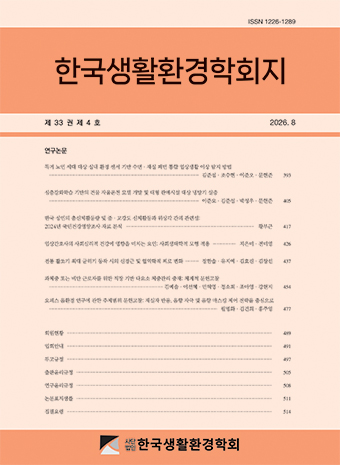
- Journal Title :Journal of The Korean Society of Living Environmental System
- Journal Title(Ko) :한국생활환경학회
- Volume : 32
- No :6
- Pages :753-768
- Received Date : 2025-10-02
- Revised Date : 2025-11-19
- Accepted Date : 2025-11-21
- DOI :https://doi.org/10.21086/ksles.2025.12.32.6.753
 Journal of The Korean Society of Living Environmental System