
Research Article

Bibang Bi Obam Assoumou, S. S., Zhu, L., & Khayeka- Wandabwa, C. (2025). Healthy building standards, their integration into green building practices and rating systems for one health. Discover Sustainability, 6(1), 796. https://doi.org/10.1007/s43621-025-01077-0
10.1007/s43621-025-01077-0Cho, K. J. (2025). Direction for revising ventilation system standards to enhance industrial competitiveness. Magazine of the SAREK, 54(6), 16-21.
Gültekin, A., & Park, J. (2023). A comparative study on the sustainable evaluation of DGNB and G-SEED focusing on IEQ enhancement. Buildings, 13(10). https://doi.org/10.3390/buildings13102538
10.3390/buildings13102538Kim, J. Y., Kim, S. J., & Lee, S. M. (2015). An analysis on current status of certification for green building revitalization in school - focused on the school located in gyeonggi-do province. Korean Education and Green Environment Research, 14(3), 9-17.
10.7743/kisee.2015.14.3.009Korea Institute of Civil Engineering and Building Technology (KICT) (2024). G-SEED Annual Report, Goyang, South Korea, 2023.
Lee, D. H. & Kim, J. M. (2019). A study on the cost impact of additional construction as rating G-SEED certification of medium-sized office buildings in Korea - Based on G-SEED 2016-2. Journal of the Architectural Institute of Korea Structure & Construction, 35(10), 225-234.
Lee, J. H. (2020). A study on the analysis and improvement measures of evaluation items in the indoor environment sector of green building certification for apartment housing, Master’s thesis, University of Seoul. RISS.
Licina, D., Wargocki, P., Pyke, C., & Altomonte, S. (2021). The future of IEQ in green building certifications. Buildings and Cities, 2(1), 907-927.
10.5334/bc.148Ministry of Land, Infrastructure and Transport (MOLIT), Notice of G-SEED, Sejong, South Korea, 2016.
Myeong, I., & Yoon, H. K. (2023). Analysis of evaluation items in the indoor environment sector of the green building certification criteria: Focusing on the indoor air environment of residential buildings. Journal of the Architectural Institute of Korea, 39(1), 217–224.
Oh, K. H. (2018). Comparative analysis of green building design techniques for office-type public buildings: Focusing on energy, environmental pollution, and indoor environment fields of green building certification [Master’s thesis, University of Seoul]. RISS. http://www.riss.kr/link?id=T14797637
Tang, K. H. D., Foo, C. Y. H., & Tan, I. S. (2020, October). A review of the green building rating systems. In IOP Conference Series: Materials Science and Engineering, 943(1), 012060, IOP Publishing.
10.1088/1757-899X/943/1/012060- Publisher :The Korean Society of Living Environmental System
- Publisher(Ko) :한국생활환경학회
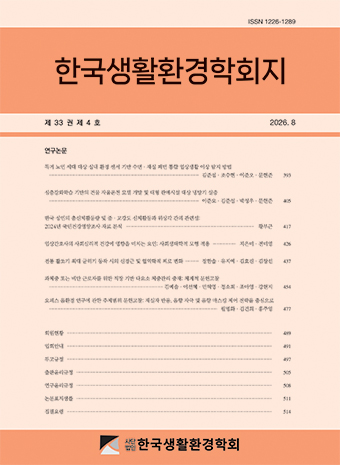
- Journal Title :Journal of The Korean Society of Living Environmental System
- Journal Title(Ko) :한국생활환경학회
- Volume : 32
- No :6
- Pages :778-789
- Received Date : 2025-11-04
- Revised Date : 2025-11-25
- Accepted Date : 2025-12-02
- DOI :https://doi.org/10.21086/ksles.2025.12.32.6.778
 Journal of The Korean Society of Living Environmental System